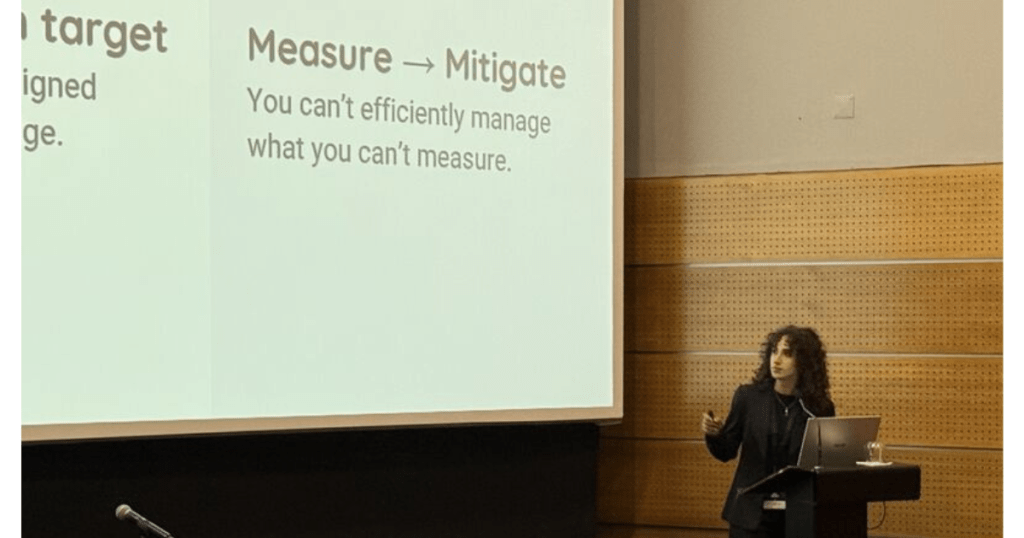
Our Animal Scientists, Sara Silvestri and Riccardo Bica, recently attended the BISAS – British & Irish Society of Animal Science Annual Conference and the EAAP – European Federation of Animal Science and ASAS – American Society of Animal Science Conference on Livestock Farming and the Environment. They presented updates from ZELP and spoke with researchers and industry leaders about enteric methane measurement and mitigation.
Here are our top three takeaways:
#1: You can’t efficiently manage what you can’t measure
The ambition to reduce emissions is there — but without accurate, repeatable measurement, it’s difficult to set baselines and prove progress. ZELP Sense is designed to help with continuous emissions monitoring of individual cows in real-world conditions including pasture. It’s quick and easy to fit, with minimal-to-no animal adaption period required and low operational needs.
#2: There’s no one-size-fits-all in methane mitigation
What works in one system won’t necessarily work in another. Many mitigation approaches require systems where animals are fed regularly and don’t work reliably in pasture settings. That’s a gap ZELP Mitigate is built to address. It’s a non-chemical device that mitigates methane, while helping farmers improve animal welfare and farm profitability, in housed, pasture, or mixed settings.
#3: Large-scale deployment requires clear farmer value
Mitigation solutions can’t just mitigate — they need to create clear upside for the farmer, often through financial gains.
- ZELP Sense helps existing solutions (like feed additives) do this by providing a practical way to verify methane reductions on-farm. This evidence builds confidence and supports outcomes-based incentives —removing the need to rely on extrapolated study results or product receipts as “proof”.
- ZELP Mitigate avoids the need for this added measurement layer: each device provides an accurate record of the methane mitigated, making verification (and the pathway to monetisation) simpler.